Bachelor of Science in Business Administration, (Completion Program) course guide
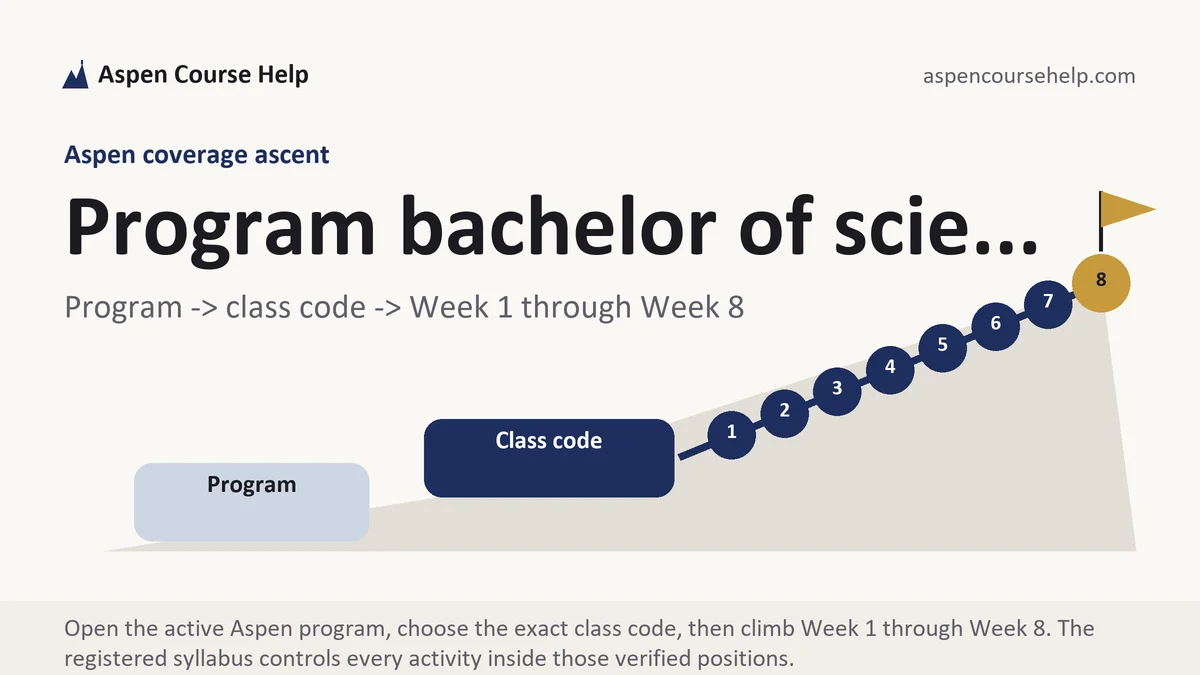
Open the registered program, choose the exact class code, then work through Aspen's native eight-Week rhythm with the live syllabus controlling every activity.
Aspen's active 2025–2026 catalog lists 20 course appearances for this business completion path. The public map below preserves that sequence. The student's degree audit remains authoritative for transfer credit, prerequisites, substitutions, residency, field requirements, and the actual order of enrollment.
Program snapshot
| Field | Verified public value |
|---|---|
| School area | Business |
| Catalog requirement | 60 Credits |
| Mapped appearances | 20 |
| Course rhythm | Eight Weeks; registered syllabus controls the work inside each Week |
| Catalog status | Active in version 1.10, effective September 1, 2025 through August 31, 2026 |
The classes in the current map
This table is a navigational transcription, not an enrollment plan. Each code opens one canonical class page shared across every current program in which Aspen lists it. From there, “The weeks, one by one” carries real links to Week 1 through Week 8.
| Position | Code | Official catalog title | Credits |
|---|---|---|---|
| 1 | BUS210 | Business Fundamentals | 3 |
| 2 | BUS305 | Business Research and Communications | 3 |
| 3 | BUS225 | Legal Environment of Business | 3 |
| 4 | MGT215 | Customer Relationship Management | 3 |
| 5 | MGT240 | Operations Management | 3 |
| 6 | BUS320 | Principles of Marketing | 3 |
| 7 | CIS315 | Business Information Systems | 3 |
| 8 | MAT350 | Quantitative Methods | 3 |
| 9 | MAT444 | Finance for Managers | 3 |
| 10 | MGT464 | Organizational Behavior | 3 |
| 11 | BUS454 | Ethical Decision Making for Business | 3 |
| 12 | MGT414 | Principles of Management | 3 |
| 13 | MGT474 | Fundamentals of Project Management | 3 |
| 14 | BUS484 | Entrepreneurship | 3 |
| 15 | CIS434 | Internet Marketing | 3 |
| 16 | CIS490 | Introduction to eBusiness | 3 |
| 17 | BUS495 | International Business | 3 |
| 18 | MGT424 | Leadership in Organizations | 3 |
| 19 | MGT494 | Strategic Management | 3 |
| 20 | BUS499 | Senior Capstone | 3 |
How this program becomes class work
Aspen's business path moves through decisions, people, operations, information, projects, and integration. A good course plan therefore tracks the decision being made, the evidence behind it, the quantitative consequence, the affected stakeholders, and the implementation test.
Build one decision ledger across the program. Record the problem, alternatives, assumptions, measures, risks, recommendation, and result for each substantial case. The ledger creates continuity without reusing previously submitted prose.
The program page is the stable map; the online classroom is the live work order. At the start of every class, copy the eight Weeks from the current syllabus into one planner with activity identity, type, instructions, rubric, weight, due time, required materials, dependencies, student action, submission state, result, and feedback. That record is more useful than a generic list because it exposes collisions among papers, discussions, quizzes, projects, and supervised obligations.
Read the Weeks without guessing
Aspen publicly verifies eight-week courses and says each Week's activities are organized in the syllabus. That supports positional Week pages, not invented labels such as “Assignment 1” or a claim that every class uses the same mixture. Open the registered Week first; capture the exact activity; then use the linked manual to plan reasoning, evidence, drafting, checking, and student submission.
The program-level quality system
For decisions, operations, finance, information, projects, and evidence-based management, quality is cumulative. Preserve an evidence ledger, decision log, term glossary, calculation record, instructor-feedback register, and source archive across classes. Carry methods and feedback forward, but never recycle previously submitted language as new work. Before each deadline, test the current deliverable against the live rubric, its named audience, required evidence, professional constraints, and the student's own registered context.
Projects, group participation, proctored or identity-controlled activities, and final submissions remain the student's. Tutoring can explain methods, test reasoning, and review student-authored work against the current rubric.
Source control and change boundary
The course identities and requirements on this page come from Aspen University's 2025–2026 Academic Catalog, version 1.10, published June 5, 2026. The catalog is effective through August 31, 2026; this map was checked July 30, 2026. Aspen's official FAQ is the source for the eight-week rhythm and live-syllabus activity boundary. Later catalog revisions, a different governing catalog, and the registered classroom supersede this page.
Questions about this map
Is this the current Aspen Bachelor of Science in Business Administration, (Completion Program) course map?
It is transcribed from Aspen University's active 2025-2026 Academic Catalog, version 1.10, and was checked July 30, 2026. A student's governing catalog, degree audit, transfers, substitutions, and advisor instructions can change the registered path.
Does every listed course have eight Week pages?
Yes. Aspen's official FAQ states that courses are eight weeks long and that each week's activities are organized in the online-classroom syllabus. Each course page links Week 1 through Week 8 without inventing the assignment inside any Week.
Can a tutor complete field, practicum, residency, or doctoral activity?
No. The student completes all supervised, experiential, approval-controlled, identity-controlled, group, and submission activity. Tutoring is limited to instruction, planning, and feedback on de-identified student work.