Capstones run here as staged projects on Aspen's 8-week rhythm: scope settled in the first days, evidence and method planned against the registered rubric, instructor feedback carried forward, and the presentation layer checked against the student-authored final work. Older examples such as BUS 799 and MED799 remain as legacy course references; the active 2025–2026 course directory controls current identities. Doctoral work has its own responsible methods desks at dissertation help and DNP help.
Why 799 courses punish improvisation
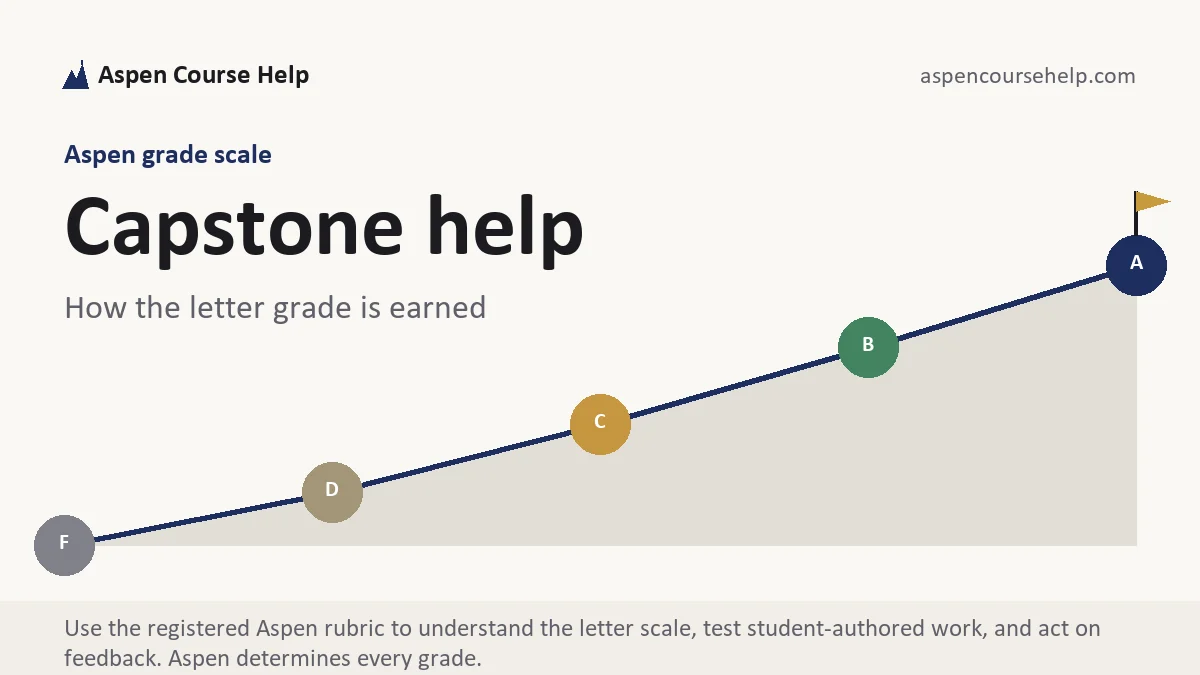
Three structural reasons. The weekly cadence bills points from week one, so a slow scoping fortnight is a quarter of the grade donated. The integrative expectation grades coherence with your own program record, which improvised finals visibly lack. And the graduate scale leaves no cushion: Aspen's graduate ladder has no D grades at all, anything at or below 69.99 percent posts as a U, and the 3.0 standing floor makes even a C expensive. A capstone is the worst possible place to meet that arithmetic unprepared, and the easiest place to avoid it with staging.
The staged method, Aspen edition
Scope in the first 72 hours
The project that fits eight weeks is the project that finishes. We shape it against the rubric and your record before anything drafts.
Inventory the program file
Your prior coursework, mapped to what the capstone will integrate. Course-length clients arrive with this organized; new arrivals send three past papers and we reverse-engineer the voice.
Draft against the weekly gates
Each week's component arrives with margin while the next is in production, and instructor feedback folds forward the day it posts.
Reconcile, then present
Numbers, claims, and terminology agree across every section before the final week, and decks or summaries generate from the finished document, never from memory.
Capstone families on the runway
- BUS 799: the MBA finale, strategy integrated, financials reconciled to the last exhibit
- MED799: the M.Ed. close, curriculum and leadership threads braided into one demonstration
- Technology and CIS finales: systems thinking documented like the professional artifact it imitates
- Psychology and addiction-studies closes: applied synthesis in clinical-adjacent register, ethics handled with gravity
- Healthcare administration finales: policy and operations integrated, exhibits consistent
The runway rule
One scheduling habit separates calm capstones from chaotic ones: never let the 799 be the course you arrive at exhausted. Aspen's biweekly Tuesday starts make a deliberate one-cycle breather before the finale nearly free, and the rhythm manual shows the math. Already inside the capstone and tired anyway? Skip the lecture, send what exists, and let the staging absorb it, rescue landings are half this desk's traffic.
The last course should feel like a formality
Send your 799 code and start date. The staged plan comes back same-day, free.